Margaret & Harold Winters (EP)
General mountain dulcimer or music discussions
Sounds good! Do you have the youtube link you can share?
I just discovered this on youtube, and thought others might enjoy it. It's a scratchy old record, but the authenticity and simplicity make it truly wonderful.
"The Fox" / "Go Away From My Window" / "I Never Shall Marry" - Margaret & Harold Winters (EP)I seldom go to festivals anymore for workshops but just to visit with dulcimer friends. However, Dwain, your workshop interests me. I might register for the Pocono festival just for that. I can easily drive over, take your workshop, and return home. I'll see when it is scheduled to take place. Thanks for offering this.
Ken
"The dulcimer sings a sweet song."
Would be great to see you there, Ken. I can't remember whether we've met before.
I talked about how we should handle our dulcimers in class (that you mention Dwain) & your workshop. We are just north of Houston and it seems one of our players was planning on going to the Pocono Festival and will look for when your workshop is posted to registrar.
Thanks, that will be great
marg.
And Marg, thanks so much for mentioning the workshop and letting me know a player is interested in it. I was raised in East Texas, and always glad to see a Texan.
I talked about how we should handle our dulcimers in class (that you mention Dwain) & your workshop. We are just north of Houston and it seems one of our players was planning on going to the Pocono Festival and will look for when your workshop is posted to registrar.
Thanks, that will be great
marg.
I like the sound of the wound bass drone with the doubled high drones a lot!
I seldom go to festivals anymore for workshops but just to visit with dulcimer friends. However, Dwain, your workshop interests me. I might register for the Pocono festival just for that. I can easily drive over, take your workshop, and return home. I'll see when it is scheduled to take place. Thanks for offering this.
Ken
"The dulcimer sings a sweet song."
(a workshop for builders and repairers on how to fix )
this would be so helpful, wish I was closer. What a good idea, I have often thought of using an older (with problems) dulcimer to demonstrate a few things, to the newer players.
If I may add a few details....
Reading the excellent books by Ralph Lee Smith: "The Story of the Dulcimer" and especially "Appalachian Dulcimer Traditions" clearly shows that the name "dulcimer" (or "dulcimore " and other variations) was already in use for the fretted dulcimer well before (at least a century) the folk revival of the 1970s. I have a little personal hypothesis about this strange disambiguation of the two types of dulcimers :
The King James I Bible, first published in 1611, quickly became the version authorized by the Church of England. The passages that interest us are in the book of Daniel: 5, 10 and 15.:
"Now if ye be ready that at what time ye hear the sound of the cornet, flute, harp, sackbut, psaltery, and dulcimer, and all kinds of musick, ye fall down and worship the image which I have made".
In this text, "dulcimer" is used to translate the Aramaic word "sumponiah", itself derived from the Greek "symphonia" (in fact, a kind of bagpipe), which the translators did not really know what to do with at the time. It was therefore the (hammered) dulcimer, very fashionable at the time, which saved them the day, thereby making this instrument an instrument of biblical times.
In the depths of Appalaches, with practically only the Bible to read, the hardy pioneers also found themselves in the embarrassment of baptizing the youngest of the family of alpine zithers, derived from the unpronounceable Dutch "scheitholt" or "zither". It was necessary to accompany the hymns, an instrument accepted by the Church, unlike the violin (the devil's box). What's better than an instrument name quoted in the Holy Scriptures? And there you have it, the Appalachian "dulcimer".
Homonymy was not a problem for almost two hundred years, when the two instruments had well separated geographical domains. It was only after the Second World War and the folk revival and the arrival of Jean Ritchie (the damsel with a dulcimer) in New York that the need for two distinct qualifiers arose : the hammered dulcimer and the pinched/plucked/fretted/lap dulcimer...
Of course, it's nothing but a(nother) hypothesis. Sorry if I was a bit long.
In the Appalachian wilderness, pioneers baptized a new instrument, derived from alpine zithers and known as the "dulcimer." Acceptable to the Church unlike the violin, it accompanied hymns, its name found in the Bible, making it ideal for religious music in the region.
By the way, at the upcoming Pocono Club Dulcimer Festival in Stroudsburg, PA (April 27, 27) I will be teaching a workshop for builders and repairers on how to fix cracks anywhere inside musical instruments, including aligning the two sides of the crackand cleaning the inside surface across the crack in preparation for glueing an interior reinforcing cross cleat.
All this is done from outside the inside the instrument! I pass all interior materials though the nearest soundhole, and clamp the crack with interior/exterior matching magnets, and clamp the cleat with a system of springs and stops. The workshop title is "Laparoscopic Crack Repair."I will be repairing a crack on an old dulcimer that was such a failure that I cut it in half to use for this sort of demonstration.
Attached is a photo of the interior cleat glued and clamped across the crack inside —all arranged with a thread passed through a small hole drilled into the crack and later repaired.
This workshop isn't on the website's schedule yet, as Norm Williams and I just talked about it last week. Builders, please spread the word!
Good information Dwain, I think I will share this with my class tomorrow.
Robin, double drone is very underrated in my opinion. I like the richness of the bass tone a lot. Some lute and baroque guitars as well as other older instruments have all strings doubled except the melody strings. This may have been for practical reasons (thinner strings were probably harder to make/more costly) but I do think it allows the melody strings to stand out more clearly from the drone.
Sometimes this sort of crack happens when the dulcimer is lifted or carried by grasping it by the top and back. The back is usually sturdier, but the top will crack at either its weakest wood grain or where the strain is greatest. The area where the top is glued to the fretboard is an area least able to respond by bending when the top is pressed by being lifted like this.
I see no reason here to suspect that was the cause, but builders regularly have to caution musicians to always lift the dulcimer by the peghead or tailblock (or strap) rather than putting the top and back into a vise-like grip between the thumb and fingers.
Similarly, trying to lift a mountain dulcimer by grasping the fretboard risks pressing fingernail dents into the top.
Welcome Rob!
You're going to love your new McSpadden, a great choice!
We would love to see it a picture of it, after you get it.
Nice to have you here @robmachin !
McSpadden dulcimers tend to be very reliable and sound wonderful.
Be sure to join our UK Group on FOTMD as well.
Thank you again,
All good & I took everyones advice and supported the sound hole, not just the one with the crack but I glued some wood under the overhangs in all the sound holes 
Yes, very glad to I was able to repair the crack and learn much, along the way.
marg
Depending on string strike timing/forces used, it's all about the waveform spectrum and the phase interplay between the pitches & the harmonics produced from this. Even slightly out of phase components between the two will cancel slightly. Conversely in-phase will reinforce, the end effect is an altered sound spectrum which won't sound like 2 pure pitches played together. This the "fullness" that is heard but not louder.
Interestingly because wave prorogation/ pressure level is governed by the square root rule to make your Dulcimers twice sound as loud as all the others you'll need to strike the strings with 4 times the force of the others players.
I think slashed fingers/broken strings would be the order of day if you tried that 
Some months ago, I was just messing around with string configurations. Doubled melody vs. doubled drone vs. 4 equidistant. It was cool to hear the differences.
Welcome,@robmachin ! Enjoy your McSpadden when it's made its way to you!
Hello everyone!
I just joined the group here at FOTMD, and thought I would say "hello". I'm totally new to Dulcimer, and about to start learning - have just ordered one from McSpadden.
I live in a small town in Buckinghamshire in England with my wife and two children, two dogs and three cats ... so I send you all greetings from there! :-)
Looking forward to taking part in the community here.
With all good wishes, Rob
Thanks all for the additional context and food for thought. My starting point was assuming that two melody strings are louder, because the fuller more pronounced tone has always made it seem louder. The first time I heard the thing about the two speakers next to each other, it was really un-intuitive to me.
The more I think about it, it makes sense to me that if two strings were tuned exactly the same, the effect of paired melody strings would be less noticeable, and the tone would not be noticeably fuller.
I also think the sympathetic resonance of the two strings off each other must help with sustain, which might feel like more volume, since the note retains its full volume for longer before fading.
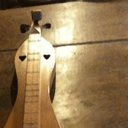
Definitely sounds very mellow and guitar like. The shape looks very similar to the folkcraft resonator dulcimers. To my eye, it looks like they took the exact shape for the resonator dulcimer and installed a saddle rather than a cone. I personally like the tone and look of that style, though it's definitely a very modern look.
Marg, as a builder I am aware of such things. If I make a dulcimer with intricate soundholes, I'll glue some tiny wood pieces under overhangs, at right angles to them, as has been discussed below. It's just a good practice to get into and prevents breakages later. Glad you were able to repair your own dulcimer!
I went ahead and reinforce all of the sound holes since each one has the grain running the same way and no support under neigh them.
Interesting, always learning something new - this time, the shapes of sound holes and what support they have under neigh them. I went and check all my dulcimers and the students ones also. Most all others have smaller sound holes without such an unprotected curve.
thanks again
marg
Marg, it looks like it cracked along the grain of an area that has no support under it. A friend of mine has something similar happen when she had her dulcimer on her lap and when she bent over to pick something up off the floor a part of her anatomy pressed down the dulcimer's top. In many old dulcimers you damage like this. It just the nature of the beast.
Ken
"The dulcimer sings a sweet song."
Everything coming along well, I peeked & it looks good but keeping it clamped till tomorrow.
It made such a loud crack noise when it happened, maybe I should be glad it wasn't a larger crack.
Is there any reason why it would have crack or been weak to crack - because of it's age or how it was stored for years, or, or , or? Is it just soft wood and fragile by the sound holes? What should I be careful for, just be careful?
Again, thanks for the guidance
If it were my dulcimer, I would glue a thin strip of wood along the underside of the crack. If you have any quarter sawn spruce, pine, or cedar, that's what I would use. I would glue the strip with the grain of the quarter sawn patch running perpendicular to the crack. It looks like you have enough room to get a clamp through the sound hole to do this. Of course, first start with super glue repair of the crack and re-enforce it.
Ken
"The dulcimer sings a sweet song."
What a great discussion!
Sometimes our ears interpret a richer or fuller sound as a 'louder' sound. As Dusty said, a decibel measuring instrument should be able to technically answer whether two melody strings are actually louder than one. It's how technicians measure the loudness of machinery or traffic noise. But there are so many more qualities to sound than simply decibels.
I like Randy's point about the two strings being struck a fraction of a second apart... However when we play two notes or two open strings a half-second apart while normally playing a tune, does that make those notes louder? If not, then why should the same action be louder if the time between striking two strings is shortened to a smaller fraction of a second as with two melody strings? Unless some sort of sympathetic vibration effect does something, as Robin mentions.
I would think it must be true- Nate's point about extra strings producing more tension on the top- and that might increase volume overall. But I can't imagine that adding one thin melody string tuned to the same pitch would do enough to hear any difference. I suppose if one added two heavy drone strings, or tuned all the strings to a higher pitch that might increase top tension enough to hear it.
As Wally mentioned, musicians often tune strings to create 'beats' that play off each other in a pleasing way. The beats of two adjacent strings tuned not quite in unison can produce an intentionally pleasing sound quality. Classical violinists do this very intentionally. Sophisticated electronic tuners make this easier to achieve nowadays whereas it used to be attempted by ear long ago.
Lastly, if you place the dulcimer on a wooden table to play, you get an immediate and very noticeable increase in sound volume. I call that 'the music box effect', and it's common practice in playing traditional dulcimer antecedents such as epinette, hummel, langspil, langelik...
Thanks Ken will give this a try. I have tape on the inside now but was wondering if thin wood & glue would be better (hadn't thought of a business card). I will pick up some slow-set glue, I think mine is just the regular 10 second superglue. The tape can stay on the inside till later if I decide I should have a bit more reinforcement.
Should I address the other sound hole to reinforce on the inside or just leave be?
Not really sure how it cracked. I was setting up before the St Paddy Day performance and with the tight area and everyone else setting up & passing bags & things back behind us & over us - did I just lay my hand on the soundboard by the sound hole - I just don't know
Sound pressure (SP) is measures in force per unit area, i.e. psi. Loudness is typically measured in decibels (DBA). The relationship between them is logarithmic, but also involves the base (atmospheric) pressure or AP. The SP is very much less than the AP. The math gets very messy.
If we assume that two strings double the sound pressure then I think we are talking about the log of [SP / (SP + AP)] versus the log of [2*SP / (SP + AP)] and you can't hear the difference, although it can be measured with a very, very sensitive sound meter.
I intentionally tune my double melody strings to slightly different frequencies to produce beat, not loudness. In the organ world the effect is called "vox celeste" or "vox humana."
Go with your ears, that's what music is about.
Whether tuned perfectly together or slightly apart in pitch, doubled strings should not be louder than one. The sound waves mesh together perfectly (or nearly perfectly) like fingers interlacing. The slight wave interferences are perceived as 'richness' of tone not increased volume.
I suggest "superglue" -- the thin, slow-set kind, not the 10 second stuff. Leave the painter's tape on the underside to support the crack but remove the upper tape so you can see the crack. With the top off of the superglue (for speed), c.a.r.e.f.u.l.l.y flex the crack open just a hair and wick drops of glue into the crack. Then close the crack gently uad hold until the glue sets.
You could glue (with Titebond not superglue) a piece of business card across the inside of the crack and trim to fit.. But the simplest reinforcement is to add another couple layers of tape inside there... carefully trimming the edges of the tape so it doesn't show, of course.
Yes, Richard has been posting youtube videos of the prototypes. This is the latest video, being played by Bing.
It looks like folkcraft is making a new dulcimer. To me it looks like a variation on the theme of a Gary Gallier design. With the tapered fretboard, the bridge is floating for lack of a better word more like a guitar setup, and a wider body. Looks like they have omitted that little jog that Gary has on his instruments reminiscent of a violin. The few pictures that I've seen of Gary playing his dulcimer for what I can tell looks like Gary is using that area for support. His knee upper leg is wedged in there. Okay that's it from my end time to do the laundry
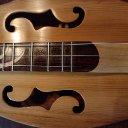
I know this must have been asked several times but if I wanted to try and take care of a crack in (maybe spruce top) soundboard - this is my Bob Lazenby Greenbriar Dulcimer, I just finished fixing the end pins & was going to use it today, at the St Paddy play.
What to use wood glue, supper glue - what about on the inside under the crack to reinforce, maybe some wood filler or a little piece of wood glued to the underside, for extra support????
The piece is still in tack, try and glue in the seam and tape to hold together, or take off and glue back on?
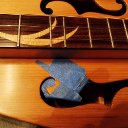
Not sure how it crack, it did seem to follow the grain, about an inch. I was getting ready to play and maybe just laid my hand on the dulcimer - just not sure but it's at a point where the cut out section of the sound hole could come off
Photo is still with taped, did this at the performance today. Looking for some information before I take the tape off.
thanks in advance
marg
I'm reminded of how subjective "loudness" is. When I was thinking about slight difference in timing and pitch two things came to mind.The first is a choir: a Google search suggests that a choir of twenty of forty people may only be perceived as twice as loud as one person, but the tonal characteristics are very different.
Another thing that came to mind is that with an extra string, more tension is applied to the instrument, and by doubling the amount of force on the melody end of the bridge, that might increase the amount of force being applied to the soundbox in that spot, making it louder.
Dusty, I am definitely not someone who has an educated guess on the topic, but intuitively I would think if you had two strings of different gauges, overall it would only be as loud as the louder string.
Also, I am not knowledgeable about subjective loudness but Im aware that our ear doesn't perceived the loudness of noise in a linear way, whereas a piece of software might show 1.5x as big of a spike, as best as I understand it, that would not correspond to 1.5x perceived loudness. I personally would not know how to interpret the data in a meaningful way.
Could it be some sympathetic vibration is in play with the doubled strings-- especially since, as Randy indicated, one string is struck a tiny fraction of a second before the other?
In a related yet unrelated matter, I play a doubled high drone and a single melody string. (String array: wound bass tuned an octave below doubled high drones then a melody string tuned either a 4th or 5th above the bass.) If I just un-double that high drone and play the same style (noter) with 4-equidistant strings, the sound is just not the same. It is fuller with the doubled high drone.
Interesting stuff to think about, at least for us dulcimer geeks.
It is not just the timing that is variable, as Mr. Adams suggests, but it is impossible to actually tune two strings to exactly the same pitch, despite our best efforts. So in practice, we have two strings not plucked at exactly the same time and not tuned to exactly the same pitch. The sum total of all of that would be an increase in sound, whether you call that volume or "fullness" or whatever.
This should not be hard to test, Nate. Turn on some kind of recording device or software and watch the input needles.
What if the two melody strings were not the same gauge? What if one were .010 and the other .014? Would the difference in tension result in greater volume?
That's an interesting question and a good point, Randy. I don't know the answer to that but I would intuitively think that playing two strings slightly out of sync that are the same gauge length and tension would not be any louder than one, but I would imagine that is why the sound is fuller.
Hey Nate. So what if one of the two speakers received a signal a portion of a second slower than the other? Perhaps a better analogy for two melody strings?